Wednesday, 29 January 2014

Vincent Van Gogh and Paul Gauguin, in Arles, 1888

The second event of 'the good mental health', in Antonin Artaud's words, of Vincent van Gogh took place on December 1888, when he was 35 years old. At that time, he was living in Arles, to where he moved back from Paris early in the year, and his brother Theo, who had received a legacy from his uncle died on proceeding July, was supporting him in various ways. While Vincent was suffering health declining due to his overwork and malnourishment, Theo managed to ask Paul Gauguin for moving to Arles to stay with Vincent. It is said that ‘Theo felt that Vincent would be happier and more stable in the company of Gauguin and also Theo had hopes that the paintings he would receive from Gauguin, in exchange for his support, would turn a profit. Unlike Vincent, Paul Gauguin was beginning to see a small degree of success from his works’ (http://www.vggallery.com/misc/bio.htm).
Gauguin arrived in Arles by train 23 October 1888 and it is said that initially both painters ‘got on well together, painting on the outskirts of Arles, discussing their art and differing techniques’ (ibid). However, deterioration of the weather took to made them being ‘compelled to stay indoors more and more frequently. As always, Vincent’s temperament (and most likely Gauguin’s as well) fluctuated to match the weather’ (ibid).
Thus, the background of the incident in the question is normally described in context of accumulation of depression in Vincent’s state of mind, unlike what French surrealist says. And the story, according to the biography, ends up in the following way:
‘On 23 December Vincent van Gogh, in an irrational fit of madness, mutilated the lower portion of his left ear. He severed the lobe with a razor, wrapped it in cloth and then took it to a brothel and presented it to one of the women there. Vincent then staggered back to the Yellow House (his famous Studio) where he collapsed. He was discovered by the police and hospitalized at the Hôtel-Dieu hospital in Arles. After sending a telegram to Theo, Gauguin left immediately for Paris, choosing not to visit Van Gogh in the hospital. Van Gogh and Gauguin would later correspond from time to time, but would never meet in person again’ (ibid).
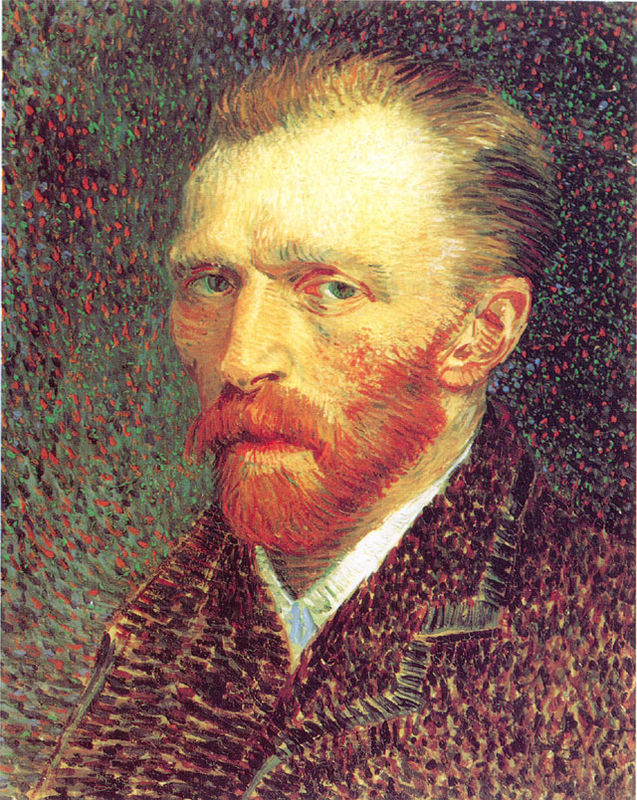
Vincent van Gogh

For reading the text in full:  http://wrex2009.wordpress.com/2011/10/10/tales-about-vincent-van-gogh-in-antonin-artaud-and-in-a-biography/

Sunday, 22 December 2013

Vincent van Gogh; the incident in the summer of 1881

Antonin Artaud, one of famous French surrealists, sums up the life of Dutch painter Vincent van Gogh, in Preface for his work titled Van Gogh, in the following way:
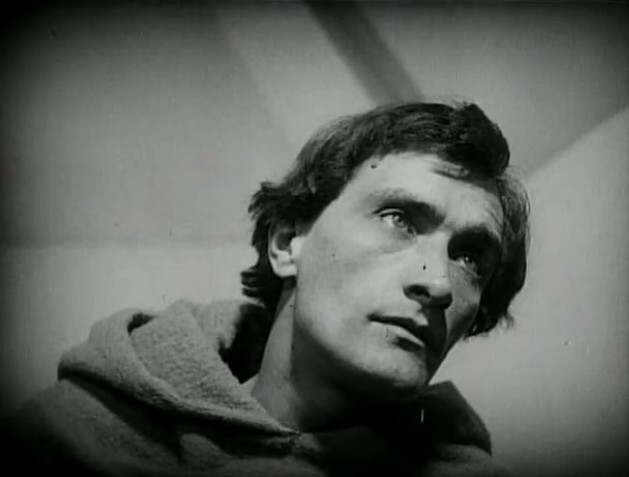
Antonin Artaud

Regardless to whether it could be appropriate to describe such horrible events were done in ‘the good mental health’ or not, it would be intriguing to make sure what exactly happened in the painter’s real life. To have certain ideas on these incidents, it would be handy to have a look at following summaries from a relatively reliable biography of Vincent van Gogh that would be easy to be found on the internet:
The first event took place in the summer of 1881, when Vincent van Gogh was 28 years old. At that time, he was living in Etten, a small village in the south of The Netherlands, with his parent. It is known that Vincent ‘applied for study at the Ecole des Beaux-Art in Brussels’ (http://www.vggallery.com/misc/bio.htm) prior to the summer, biographers disagree on whether his application was accepted or not. Whatever the case, the event took place during he was living in Etten, and soon after he came across with a girl called Kee:
‘he met his cousin Cornelia Adriana Vos-Stricker (Kee). Kee… had been recently widowed and was raising a young son on her own. Vincent fell in love with Kee and was devastated when she rejected his advances… After being spurned by Kee, Vincent decided to confront her at her parents’ house. Kee’s father refused to let Vincent see his daughter and Vincent, ever determined, put his hand over the funnel of an oil lamp, intentionally burning himself. Vincent’s intent was to hold his hand over the flame until he was allowed to see Kee. Kee’s father quickly defused the situation by simply blowing out the lamp and Vincent left the house humiliated’ (ibid).

For reading the text in full:  http://wrex2009.wordpress.com/2011/10/10/tales-about-vincent-van-gogh-in-antonin-artaud-and-in-a-biography/
An informative Vincent van Gogh website: https://www.artsy.net/artist/vincent-van-gogh

Thursday, 21 November 2013

22 November, 1963

On 22 November in 1963, the world lost three famous people in this same single day; needless to say, the most famous and important figure among these three was John F. Kennedy, the President of the United State; and other two were both famous writers; Aldous Huxley, of Brave New World, and C. S. Lewis, of The Chronicles of Narnia.
The assassination of the President J. F. Kennedy has been discussed and analysed for years and years, however, the deaths of other two writers has caught far fewer attention except for their specific researchers or devoted fans. This blog entry simply attempts to work out how each of them died individually and, hopefully, would like to align the deaths in chronological order.

As everybody knows, John F. Kennedy was assassinated in Dallas, Texas, on this day, while his ‘presidential motorcade was travelling through the main business area of the city’ (http://news.bbc.co.uk/onthisday/hi/dates/stories/november/22/newsid_2451000/2451143.stm). According to the article, the President was ‘hit in the head and throat when three shots were fired at his open-topped car’ (ibid) while the car was slowly passing through Dealey Plaza at about 13:25 local time. Soon after the shooting, ‘Mr Kennedy’s limousine was driven at speed to Parklands Hospital’ (ibid), and even ‘The president was alive when he was admitted’ (ibid), unfortunately, the article concludes that the President Kennedy ‘died at 1400 local time (1900 GMT)’ (ibid).
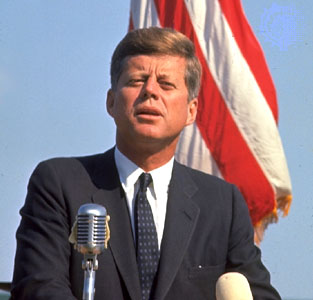
John F. Kennedy

Approximately an hour before J. F. K was hit, at about 18:25 in Greenwich Mean Time, C. S. Lewis died at his home called The Kiln, where he had been living since 1929,  in Oxford, England. It is said that ‘He had resigned his position at ( the Chair of Medieval and Renaissance Literature at) Cambridge (that he had accepted in 1954) during the summer’ due to his health issues and he ‘died at 5:30 p.m… on Friday, November 22, after a variety of illnesses, including a heart attack and kidney problems’ (http://cslewis.drzeus.net/bio/).

Finally, as for the time and circumstance of Aldous Huxley’s death, it can be confirmed that he ‘died of cancer at home in Hollywood on 22 November 1963, unaware that President J. F. Kennedy had been assassinated earlier that afternoon in Dallas’ (Bradshaw, 2005, p xiv)*. Although sources like Wikipedia give the concrete time of his death; at 5:20 pm in local time, since sources like this are usually regarded as untrustworthy in academic fields, this blog decides to satisfy with providing the chronological order of the deaths as; (1) C. S. Lewis at 17:30 GMT, (2) John F. Kennedy at 19:00 GMT and (3) Aldous Huxley at later than both of them.

*Bradshaw, David (2005), Biographical Introduction for The Devils of Loudun by Aldous Huxley

Tuesday, 19 November 2013

Plato's hypothetical refutation against Aristotle

As Socrates’s example clearly shows, wisdom at its wisest only achieves to wisdom as not knowing due to ‘the limited nature of human knowing—as he says, all human wisdom is worthless, nothing, in other words, fallible. Even in their best operation, even regarding those beliefs for which we have the best reasons, and spent the most time considering, human knowing is still fallible, and error is still possible’ (http://www.carroll.edu/msmillie/perspectives/wisdomasexcellence.htm). A clear cut difference between Aristotle and Plato here is, while Aristotle sticks to conduct his causal investigation, following the tradition of his predecessors, basically by counting on his own human might, Plato rather recommends Socratic dialectic to minimise the effect of human fallibility, since it helps to ‘overcome our own defensiveness, prejudice, haste, lack of confidence’ (ibid).

However Aristotle’s causal investigation could be more realistic or scientific, in Plato’s view it would be ended up to be described as it follows: ‘We learn about physical objects empirically, by means of the senses: we look at them, taste them, listen to them, and so on. But none of the information we gain in this way is reliable or trustworthy: we don’t have real knowledge of the visible world, just mere “opinion.”… Empirical evidence is at best irrelevant, at worst misleading’ (http://www.trinity.edu/cbrown/intro/plato_two_worlds.html). Having rejected to learn by means of the sense, Plato tries to replace it with means of Reason. Upon this differentiation, once again, Plato inevitably goes back to his two world theory. In his view, ‘Our physical bodies are a part of the visible world. Our bodies are responsible for our appetites. Our sense organs, by means of which we learn about the visible world… But there’s also another part of us which links us with the eternal realm of the Forms, namely our soul (which for Plato is more or less identical with our reason). So one result of coming to learn about the Forms is that we will become less concerned with physical matters; we will be less governed by our appetites, and less reliant on our unreliable senses for knowledge’ (ibid).
Plato

For reading the text in full: http://wrex2009.wordpress.com/2013/11/04/plato-and-aristotle-in-their-ontological-and-teleological-views/

Monday, 18 November 2013

Aristotle's teleological final cause and Socrates's wisdom in Plato's 'Apology'

Among Aristotle's four causes, the final cause only regards to explain why it is and by providing this, it is argued that ‘Aristotle offers a teleological explanation… that is to say, an explanation that makes a reference to the telos or end of the process’ (http://plato.stanford.edu/entries/aristotle-causality/#FouCau). In general, it is said that ‘for Aristotle, an end (telos) is always something good’ (http://ndpr.nd.edu/news/39290-teleology-first-principles-and-scientific-method-in-aristotle-s-biology/). Strictly speaking, ‘final causation requires invoking the good as a per se cause. This is why Aristotle thinks no one before him grasped the final cause. For they may have employed the good in their accounts but only as an incidental cause’ (ibid). In this quest for the good as per se (good in itself), Aristotle’s tune resonates with his old mentor, Plato, whose teaching could be summarised in a following way: ‘A life focused on the question of its greatest good is a life lived to its fullest—an excellent or virtuous life’ (http://www.carroll.edu/msmillie/perspectives/wisdomasexcellence.htm).

Seeking for the good as per se, or the greatest good, whilst Aristotle takes a direction for the Ethics, Plato sees the best example in his old mentor, Socrates, and whose wisdom. In Plato’s Apology, Socrates ‘identifies his activity with “wisdom”’ (ibid) as the wisest who ‘understands that his wisdom is worthless’ (ibid). This wisdom, and its ultimate state called wisdom as not knowing, provide the very basis of Plato’s thoughts. From his first-hand experience, Plato impersonates his late mentor and retells, ‘…the greatest good for a man [is] to discuss virtue [excellence] every day… for the unexamined life is not worth living for men’ (ibid).
Socrates

For reading the text in full: http://wrex2009.wordpress.com/2013/11/04/plato-and-aristotle-in-their-ontological-and-teleological-views/

Sunday, 17 November 2013

Aristotle's Four Causes

It has been criticised that what Aristotle counts as the form or ‘primary substance is one that is not in any way universal’ (http://faculty.washington.edu/smcohen/320/zeta17.htm). Nevertheless, Aristotle insists that ‘Substances are supposed to be objects of knowledge, and objects of knowledge are universals… (and are supposed to be) definable’ (ibid). As for knowledge, in its proper meaning, he also gives a following condition: ‘we think we have knowledge of a thing only when we have grasped its cause’ (http://plato.stanford.edu/entries/aristotle-causality/#FouCau). As for causes, through examining traditional causal investigations conducted by his predecessors, he reaches to a conclusion that ‘all his predecessors were engaged in an investigation that eventuated in knowledge of one or more of the following causes: material, formal, efficient and final cause’ (ibid). In summary, Aristotle supposedly means ‘proper knowledge is knowledge of the cause’ (ibid). Here, it would be useful to mention that what Aristotle actually had in mind was something that could be only described by using the Greek word aitia, which ‘is translated as “causes,” is probably better rendered as “that which explains”’ (http://www.philosophicalinvestigations.co.uk/index.php/philosophy/artistotle/1032-essay). In other words, ‘knowledge of the form or essence is in effect knowledge of the thing’s causes, of what explains why it is what it is’ (ibid). As a result of these arguments, Aristotle gives one of his flagship accounts known as the Four Causes, which can be summarised as following:
  • ‘The material cause: “that out of which”, e.g., the bronze of a statue.
  • The formal cause: “the form”, “the account of what-it-is-to-be”, e.g., the shape of a statue.
  • The efficient cause: “the primary source of the change or rest”, e.g., the artisan, the art of      bronze-casting the statue, the man who gives advice, the father of the child.
  • The final cause: “the end, that for the sake of which a thing is done”, e.g., health is the end of walking, losing weight, purging, drugs, and surgical tools’ (http://plato.stanford.edu/entries/aristotle-causality/#FouCau).
Source: http://iraknol.wordpress.com/article/aristotle-s-physics-the-four-causes-3ncxde0rz8dtk-8/

For reading the text in full: http://wrex2009.wordpress.com/2013/11/04/plato-and-aristotle-in-their-ontological-and-teleological-views/

Saturday, 16 November 2013

Aristotle's Form as Substance

In the Metaphysics, Aristotle 'suggests that a compound (of form and matter) cannot be a substance (Z3, 1029a30)’ (http://faculty.washington.edu/smcohen/320/zeta17.htm). Instead, he defines requirements to be a substance as being ‘separable and a this something’ (ibid) .

Subsequently, Aristotle ‘considers the claim of matter to be substance, and rejects it’ (ibid) because ‘Substance must be separable and a this something (individual)’ (ibid). To cut a long story short, it could be summarised that ‘perhaps Aristotle’s point is not that matter is neither separable nor individual; all he is committed to saying is that matter fails to be both separable and individual’ (ibid), therefore, ‘The only remaining candidate for primary substance seems to be form’ (ibid). Whilst the form Plato argued was separable from their shadows in the visible world, it is said that the form Aristotle argues is not ‘separable from all matter (except, perhaps, in thought). And it cannot exist if it is not the form of something’ (ibid). In his logic, individual substances are ‘compounds of matter and form’ (ibid), and ‘they’re not just unstructured collections of elements, but have a structure that is essential to their being what they are’ (ibid). In this relation, the form provides matter ‘a structure that is essential to their being what they are’ (ibid), therefore, ‘the form of a compound substance is essential to it (whilst) its matter is accidental’ (ibid). Due to its own nature, the form in Aristotle ‘is not a “thing,” (but)… the way something is’ (ibid) and this is where his form differs from Plato’s and where the following criticism arises from; what Aristotle counts as the form or ‘primary substance is one that is not in any way universal’ (ibid).
Aristotle

For reading the text in full: http://wrex2009.wordpress.com/2013/11/04/plato-and-aristotle-in-their-ontological-and-teleological-views/