Wednesday, 11 June 2014

Akhenaten's Aten; self-deification, Amun priesthood and grammatical monotheism

Due to his father’s death, the son succeeded the throne initially as Amenhotep IV in 1353 B.C. The new pharaoh seems to have shown his interests on launching a radical religious reform from relatively early years of his reign. Within a year or two since he took the throne, Amenhotep IV began to build ‘temples to the Aten or divinised sun-disk at Karnak in a very different artistic style’ (http://www.bbc.co.uk/history/ancient/egyptians/akhenaten_01.shtml) and he also changed his name from Amenhotep, which means ‘Amun is content’ – honouring the state god Amun-Re – to Akhenaten, meaning ‘effective for the Aten’ (http://www.telegraph.co.uk/culture/art/10561090/Akhenaten-mad-bad-or-brilliant.html). Meanwhile, there are some arguments that point out some connections between the possible self-deification of Amenhotep III in his life time and Akhenaten’s worship of Aten. It is said that ‘Amenhotep III was somewhat insistent that he be identified with this sun god during his lifetime’ (http://www.touregypt.net/featurestories/amenhotep3.htm), therefore ‘the worship of the sun god, Aten, by his son may have directly or indirectly also involved the worship of his father’ (ibid). Furthermore, some scholars suggest Akhenaten’s ‘cult of Aten was a simple admiration for his father. They point out that the name Aten, which was pronounced yati, sounded much like the Egyptian word for father, perhaps pronounced yata‘ http://books.google.co.za/books?id=JADDYAZ9GIIC&pg=PA199&lpg=PA199&dq=amenhotep+iii+iv+co-regent&source=bl&ots=071zZVA-nD&sig=cNv_RhGWv7X9eKIZZUqDDRXuVT4&hl=en&sa=X&ei=KawpU-7QMYPKhAe1jIGQAQ&ved=0CDEQ6AEwAQ#v=onepage&q=amenhotep%20iii%20iv%20co-regent&f=false). For the argument’s sake, it would be also important to point out that Egyptian pharaohes were ‘expected to merge with the sun after his death’ (http://www.touregypt.net/featurestories/amenhotep3.htm) and there is no physical evidence that proves ‘Amenhotep III (being regarded) as a major deity during his lifetime’ (ibid).
Aten (sun-disk)
Regardless to whether his worship involved the deification of his father or not, Akhenaten’s next step towards his religious reform shows unparalleled uniqueness of this pharaoh in the Egyptian history: ‘In the fifth year of his reign, around the time that he changed his name, Akhenaten decided to build a new royal capital’ (http://www.telegraph.co.uk/culture/art/10561090/Akhenaten-mad-bad-or-brilliant.html). In doing so, he made it clear that ‘the worship of the Aten required a location uncontaminated by the cults of traditional gods’ ( http://www.bbc.co.uk/history/ancient/egyptians/akhenaten_01.shtml) and in this logic, he decided to ‘ban the traditional gods altogether, making redundant up to 2,000 time-honoured deities’ (http://www.telegraph.co.uk/culture/art/10561090/Akhenaten-mad-bad-or-brilliant.html). Taking the contemporary circumstance into the consideration, Akhenaten’s religious reform, in political view point, could be recognised as ‘declaration of warfare against the dominant religious authority in the day, the Amun priesthood based in Thebes… which by then was siphoning off a hefty percentage of the taxes collected in Egypt’ (http://www.usu.edu/markdamen/1320Hist&Civ/chapters/10AKHEN.htm). Whatever the case, Akhenaten then ‘began closing down Amun temples across Egypt and even had the name Amun erased from some inscriptions. Later, he went so far as to order the word “gods” removed and changed to “god,” wherever it occurred in public inscriptions. Whether or not this is monotheism by theological standards, it’s certainly grammatical monotheism (ibid). In terms of theological view point, the key elements of this grammatical monotheism could be represented in the following account: ‘Akhenaten’s aten is the font of all being, which means by nature he cannot be restricted in form, and thus is almost always presented as the aptly universal and geometric solar circle… Even to say “he” of the aten is perhaps too restrictive for this universalist conception of deity—gender is clearly not relevant to sun-disks’ (ibid). Nonetheless, even though his religious reform is said to have ‘raised the Aten to the position of “sole god”… Akhenaten’s religion is probably not strictly speaking monotheistic, although only the Aten is actually worshipped and provided with temples. Other gods still existed and are mentioned in inscriptions’ ( http://www.bbc.co.uk/history/ancient/egyptians/akhenaten_01.shtml).

Tuesday, 10 June 2014

Amenhotep III and Akhenaten, co-regency theory

Before moving to the reign of Akhenaten, it should be pointed out that ‘There is much debate about when his rule started. Some suggest he was Amenhotep III’s co-regent for up to 12 years; others think Amenhotep III died before his son took over’ (http://books.google.co.za/books?id=JADDYAZ9GIIC&pg=PA199&lpg=PA199&dq=amenhotep+iii+iv+co-regent&source=bl&ots=071zZVA-nD&sig=cNv_RhGWv7X9eKIZZUqDDRXuVT4&hl=en&sa=X&ei=KawpU-7QMYPKhAe1jIGQAQ&ved=0CDEQ6AEwAQ#v=onepage&q=amenhotep%20iii%20iv%20co-regent&f=false). While art historians tend to argue for co-regency theory ‘ because this would explain the mixture in artistic styles’ (ibid) during the overlapping period between Amenhotep III and Akhenaten, other scholars who work with written sources ‘see no conclusive evidence for co-regency, certainly not one that lasted more than a couple years’ (ibid). Now, it would be worthwhile to apply the given account – Amenhotep III died in 1353 BC at the age of 45 – to the theories above:

If the co-regency lasted for 12 years, it must have started when Amenhotep III was about 33 years old. Given another factor that Akhenaten was the pharaoh’s second son, his birth can hardly be traced back to the time before his father was 14 years old at least. However, being the ‘second son’ doesn't necessarily mean that he was the ‘second born’ child among his siblings including four sisters. If Queen Tiy gave birth one child every year since her husband turned to 13 years old, at the time when the sixth child was born, the pharaoh must have been the age of 18. If Akhenaten was the fifth or sixth child, when the co-regency began, he was most likely in his age of 16 or 17. The same calculation applies to the case where the co-regency of two years; he was 26 or 27 years old whilst his father was 43, and the case where there was no such thing as the co-regency; he was older than 29 years old when his father died at the age of 45, respectively. Therefore, by simply calculating possible ages of the pharaoh and his son, it would be safe to say that technically all theories can not be rejected in this criteria alone.
Amenhotep III

  
In addition, as for the later years of Amenhotep III, it is argued that ‘to judge from his last portraits, (Amenhotep III) suffered a lingering malady of some sort which slowly killed him, so it would make sense that, as his health declined, he handed at least some of the reins of government to his chosen successor’ (http://www.usu.edu/markdamen/1320Hist&Civ/chapters/10AKHEN.htm). This allegation has been even endorsed by examinations of his mummy, however, others oppose against this argument by pointing out that ‘the identity of his mummy is uncertain’ (http://books.google.co.za/books?id=JADDYAZ9GIIC&pg=PA199&lpg=PA199&dq=amenhotep+iii+iv+co-regent&source=bl&ots=071zZVA-nD&sig=cNv_RhGWv7X9eKIZZUqDDRXuVT4&hl=en&sa=X&ei=KawpU-7QMYPKhAe1jIGQAQ&ved=0CDEQ6AEwAQ#v=onepage&q=amenhotep%20iii%20iv%20co-regent&f=false).

For reading the text in full: 
http://wrex2009.wordpress.com/2014/06/01/akhenaten/

Monday, 9 June 2014

Akhenaten: the second son of Amenhotep III

Akhenaten is one of famous pharaohs in the history of ancient Egypt, not only because he was the father of King Tut, but also for his extremely unique reign. Some give him a credit as the founder of the monotheism in the world history or positively assert him as ‘history’s first individual’ (http://www.telegraph.co.uk/culture/art/10561090/Akhenaten-mad-bad-or-brilliant.html), whilst criticism is also associated with such views saying, ‘modern history has been kinder to him: we perhaps value individualism more’ (ibid) than the pharaoh’s contemporaries and successors, who tried to delete him from the historical record completely. 
It is said that Akhenaten was born as the second son of Amenhotep III, who ‘ruled for almost 40 years during the 18th Dynasty of Egypt’s history that represented one of its most prosperous and stable periods’ (http://www.touregypt.net/featurestories/amenhotep3.htm). The foundation of this stability was largely established by Tuthmosis III, the pharaoh’s grandfather, so that ‘little or no military actions were called for’ (ibid) during the pharaoh’s reign. Despite his fame as a successful pharaoh, little is known about when actually he bagan to rule. It is widely accepted that ‘Amenhotep III succeeded to the throne… as a child, sometime between the ages of two and twelve years of age… at the time of his father’s death. It is unlikely that his mother, Mutemwiya, served as a regent for the young king, and whoever may have been in charge at the beginning of his reign seems to have remained in the background’ (ibid).
Tuthmosis III
Regardless to his actual age, it is said that Amenhotep III married Queen Tiy, the principle queen of the pharaoh, ‘in year two of his reign’ (ibid) and Tiy gave birth to ‘at least six of his children consisting of two sons and four daughters’ (ibid). Since he was not the eldest son, ‘Akhenaten was not supposed to become pharaoh. The son of Amenhotep III… Prince Amenhotep, as he was then called, was younger brother to the crown Prince Thutmose’ (http://www.telegraph.co.uk/culture/art/10561090/Akhenaten-mad-bad-or-brilliant.html). However, Thutmose’s unexpected early death made Akhenaten the sole surviving heir and ‘when his father died in 1353 BC, he took the throne as Amenhotep IV’ (ibid). In addition, it is allegedly said that ‘Amenhotep III may have died in about the 39th year of his rule, perhaps when he was only 45 years old. His wife, Tiy, apparently outlived him by as many as twelve years’ (http://www.touregypt.net/featurestories/amenhotep3.htm).

Sunday, 8 June 2014

The deaths of Abner and Ish-bosheth,and David, king of Israel

It was a huge blow for Ish-bosheth to lose Abner’s support so that he ‘dared not refuse David’s demand for the return of Michal’ (http://www.jewishencyclopedia.com/view.jsp?artid=276&letter=I), a daughter of Saul, when the demand was made aiming at emphasizing David’s claim to the throne. After that, Abner was killed by one of David’s commanders ‘in an act of vengeance’ (http://www.aboutbibleprophecy.com/p188.htm). To this incident, David reprimanded his commander in question and ‘had Abner buried with full honors’ (ibid). Consequently, the death of Abner ‘prompted two of his captains, Baanah and Rechab, to slay Ish-bosheth’ (http://www.jewishencyclopedia.com/view.jsp?artid=276&letter=I) and when they ‘carried the head of the unfortunate king’ (ibid) to David, expecting to be rewarded, on the contrary, David ‘put them to an ignominious death’ (ibid).
Ish-bosheth, beheaded
Thus, through such a long and winding way, finally David was ‘accepted by all Israel and anointed king’ (http://www.newadvent.org/cathen/04642b.htm).

Abner's change sides from Ish-bosheth to David, during the civil war

Opposing to David’s claim to the throne and his second anointment at Hebron, Ish-Bosheth, the sole surviving son of king Saul, ‘resided in fortified Mahanaim, east of the Jordan, that place being secure against the Philistines’ (http://www.jewishencyclopedia.com/view.jsp?artid=276&letter=I). It is also argued that it was largely depended on Abner’s political skill and influence that enabled ‘securing for Ish-bosheth the allegiance of all the tribes west of the Jordan with the exception of that of Judah’ (ibid). This unstable state of nation lasted for about two years before the civil war broke out between the two contestants for the throne.
Abner leaves David
In the early phase of the civil war, ‘Abner killed… a brother of… one of David’s military officers…in self- defense’ (http://www.aboutbibleprophecy.com/p188.htm) but eventually he was defeated by the David’s force at Gabaon. Subsequently, ‘David gradually but surely extended his authority’ (http://www.jewishencyclopedia.com/view.jsp?artid=276&letter=I) so that he could even father six sons in Hebron. Meanwhile, Ish-bosheth accused Abner of his relationship with one of Saul’s concubines that seemed like ‘plotting to take over the kingship’ (http://www.aboutbibleprophecy.com/p188.htm). This quarrel led Abner to change his side to David and he ‘persuaded all the tribes to follow David’s leadership’ (ibid).
For reading the text in full:http://wrex2009.wordpress.com/2011/09/13/how-did-king-david-succeeded-the-throne/

Wednesday, 4 June 2014

David's gaining of reputation and the second anointment at Hebron

There is a long and complicated story between the first and second anointments. However, to cut a long story short, it can be summarised to following events: (1) David was first brought to the court, when King Saul was suffering from an illness, ‘to soothe the king by playing on the harp’ (http://www.newadvent.org/cathen/04642b.htm). (2) David gained his fame as a warrior too when he volunteered to fight a single combat against a giant called Goliath and managed to slay him, as a part of Saul’s war against the Philistines. (3) His ‘victory over Goliath won for him the tender friendship of Jonathan, the son of Saul’ (ibid) and he was also offered to marry Saul’s daughters; Merob and Michol. (4) However, David’s ‘great popularity and the imprudent songs of the women excited the jealousy of the king’ (ibid) and eventually, this situation forced David to flee from the court. (5) While David was in the state of exile, the battle on Mount Gilboa took place, where Saul and his three sons including Jonathan were all slain by the Philistines.
David versus Goliath
The death of Saul meant that there arose a vacancy in the throne of Israel. Although David was already anointed by Samuel the judge, as its significance was not recognised, it must have been natural for Abner, the late Saul’s highest military commander, to establish Ish-bosheth (Ishbosheth / Isboseth), the sole surviving son of Saul, as the successor of his father’s throne. In the mean time, ‘David, who was now thirty years old, went up to Hebron to claim the kingly power. The men of Juda accepted him as king, and he was again anointed, solemnly and publicly’ (ibid). Although it is described that  David’s claim was done by ‘God’s command’ (ibid), it was only the tribe of Judah (Juda) that acknowledged David’s claim while other eleven tribes all remained faithful to the legitimacy of Ish-bosheth.

Sunday, 1 June 2014

The first anointment of King David

In general, King David is recognised as the second king of Israel, who succeeded the throne of King Saul, the first king, who was anointed by Samuel, the last Judge. However, according to the Old Testament, the anointment of David for becoming the king of Israel actually took place for three times and there was another candidate for the succession. 
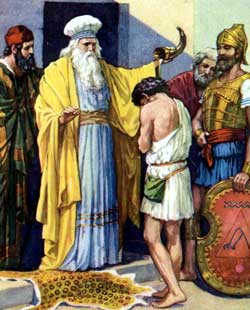
Samuel anoints David, a shepherd boy
The story surrounding the first anointment of David rather belongs to a background story of his early life. According to the Old Testaments, David was ‘the youngest of the eight sons of Isai, or Jesse… a small proprietor, of the tribe of Juda, dwelling at Bethlehem, where David was born’ (http://www.newadvent.org/cathen/04642b.htm). In his young years, David worked as a shepherd helping his father while Saul was ruling the country as the anointed King of Israel. One day, however, ‘Samuel, the Prophet and last of the judges, had been sent to anoint him in place of Saul, whom God had rejected for disobedience’ (ibid). Although this first anointment had either religious and political significance due to the fact that it was performed by Samuel, the same person who had anointed the current king, nobody around him did ‘seem to have recognized the significance of this unction’ (ibid) and David simply went back to his work.